.png)
The Anatomy of a Successful Translation Project
Every translation project has its own story — from the moment a client sends a request to the moment the final file is delivered.
But behind every seamless delivery stands something invisible: a well-structured process. Successful translation project management is not about luck — it’s about having a clear framework that ensures quality, consistency, and client satisfaction every single time.
Below, we’ll break down the anatomy of a successful translation project and see what makes it work.
1. Clear Project Scope and Communication
Every project starts with understanding.
A project manager must clarify the client’s goals, target audience, preferred style, and technical requirements. Miscommunication at this stage can cost hours later.
Key steps include:
- Gathering and reviewing all source files and references
- Clarifying deliverables and deadlines
- Identifying potential risks or ambiguities early
- Documenting everything in the project management system
Clear communication turns uncertainty into confidence — both for the team and the client.
2. The Right Team and Resources
No translation project succeeds without the right people.
Selecting linguists with the right subject-matter expertise, ensuring their availability, and aligning editors and proofreaders are the cornerstones of a reliable workflow.
Best practices for project managers:
- Choose linguists based on proven domain experience
- Share style guides, glossaries, and instructions in advance
- Secure NDAs and contracts before kickoff
- Prepare backup options to handle unexpected changes
A great team makes complex projects look effortless.
3. Efficient Workflow and Technology
Modern translation projects rely on smart tools.
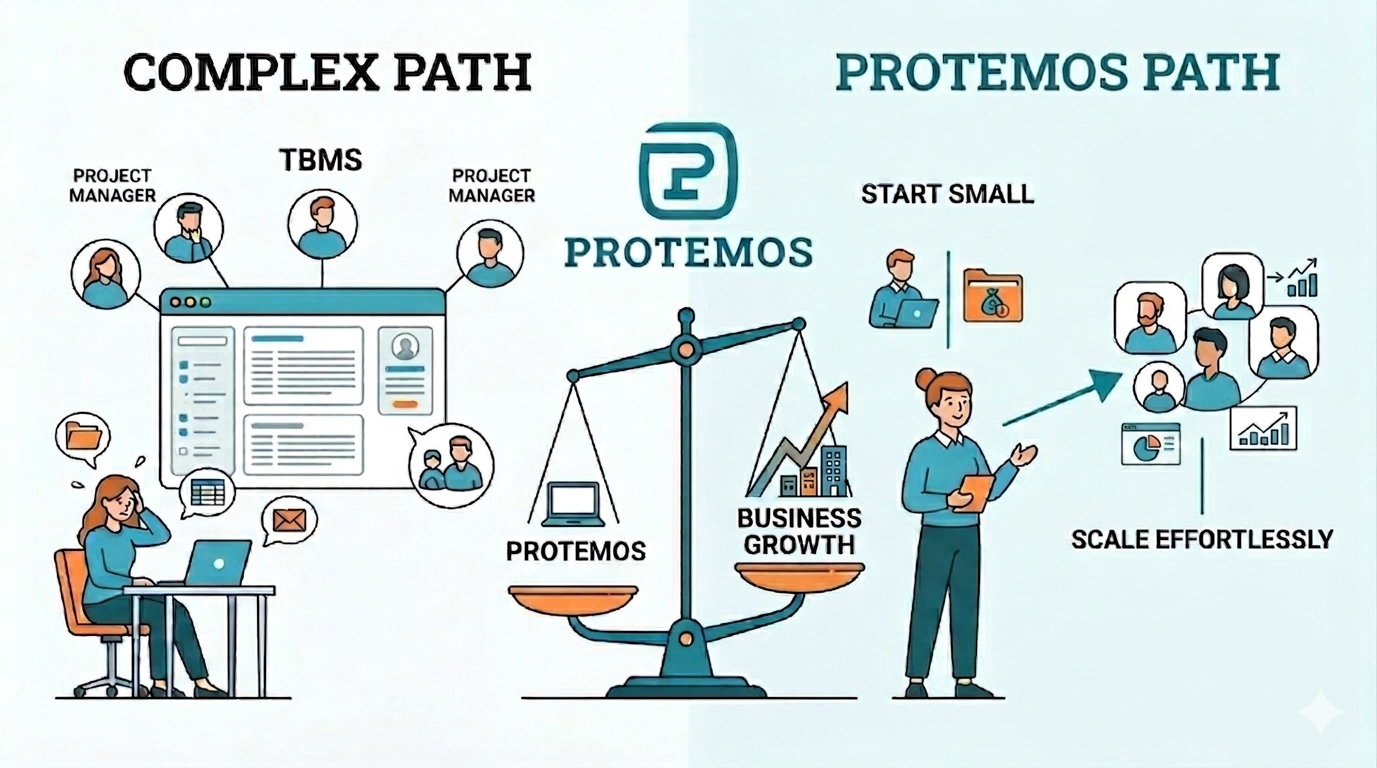
From CAT tools to translation business management systems (TBMS) like Protemos, technology helps project managers save time, reduce errors, and keep everything organized.
A streamlined workflow should include:
- Centralized project setup and tracking
- Automated notifications for deadlines and task status
- Integration of translation memory and terminology databases
- Real-time collaboration between linguists and reviewers
Automation doesn’t replace human expertise — it amplifies it.
4. Rigorous Quality Assurance (QA)
Even the best translators make mistakes.
That’s why structured quality assurance is non-negotiable in translation project management.
Essential QA steps:
- Linguistic review by a second linguist
- Consistency checks using QA tools
- Verification of formatting, numbers, and tags
- Final proofreading before delivery
Quality is not a one-time action — it’s a continuous process that protects both the agency’s and the client’s reputation.
5. Transparent Delivery and Feedback
The final delivery is where the client forms their lasting impression.
Professionalism shows in every detail: clear file names, organized folders, polite communication, and on-time delivery.
Don’t forget to:
- Double-check file formats and completeness
- Send a concise and friendly delivery email
- Ask for client feedback and respond promptly
Feedback turns good projects into better ones. It’s the loop that keeps your process evolving.
6. Post-Project Evaluation
Once the project is over, analysis begins.
A professional project manager tracks performance metrics — deadlines met, quality scores, client satisfaction, and vendor reliability. These insights help optimize future workflows.
Post-project actions:
- Record vendor ratings and notes
- Log financials and invoicing in the system
- Archive files for traceability
- Document lessons learned
Continuous improvement is what separates good LSPs from great ones.
Conclusion
A successful translation project isn’t magic — it’s structure, communication, and consistency.
When every stage — from planning to delivery — follows a clear process, quality becomes predictable, clients stay happy, and teams stay productive.
Checklists and discipline build the foundation.
Automation takes it to the next level
.png)
.png)