
How to Choose a TBMS for a Small Translation Company
For most small and mid-sized translation companies, the decision to implement a translation business management system (TBMS) is straightforward.
At some point, spreadsheets simply stop working well enough:
- Project tracking becomes messy.
- Files are scattered across emails and folders.
- Financial visibility is limited.
- Too much time is spent on routine tasks that should be automated.
A TBMS is the natural next step. But this is where things often become unexpectedly difficult.
When the First Step Is Too Big
In theory, choosing a TBMS should be simple. You find a system, start using it, and gradually improve your processes. In practice, many providers structure this very differently.
You are asked to make a significant upfront commitment. This may include:
- An “entry fee” just to get started.
- A requirement to purchase multiple licenses from day one (even if your team realistically needs only one or two users at the beginning).
For a small company, this creates friction immediately. You are not just choosing a tool. You are being asked to make a financial decision that may not match your current stage.
Why This Becomes a Real Problem
At an early stage, most translation companies operate with small, flexible teams. You may have:
- One project manager
- The owner involved in operations
- A few external vendors
In this setup, you do not need five full TBMS licenses. You need one, maybe two. But if the system forces you to buy more than you actually need, two things happen:
- Either you overpay for capacity you are not using.
- Or you just postpone the decision entirely.
In many cases, companies choose to wait. They continue working with spreadsheets, emails, and manual processes longer than they should. Not because they prefer it, but because the entry barrier to a proper system is too high.
The Hidden Cost of Waiting
At first, working without a TBMS feels manageable. But as the number of projects grows, inefficiencies accumulate:
- More time is spent on coordination.
- Errors become more likely.
- Profitability is harder to track.
- Scaling the business becomes more difficult.
Eventually, implementing a TBMS becomes not just a step forward, but a painful transition. The larger the team, the harder it is to change established processes. In other words, delaying adoption often makes the future implementation more complex and more expensive.
A More Practical Approach
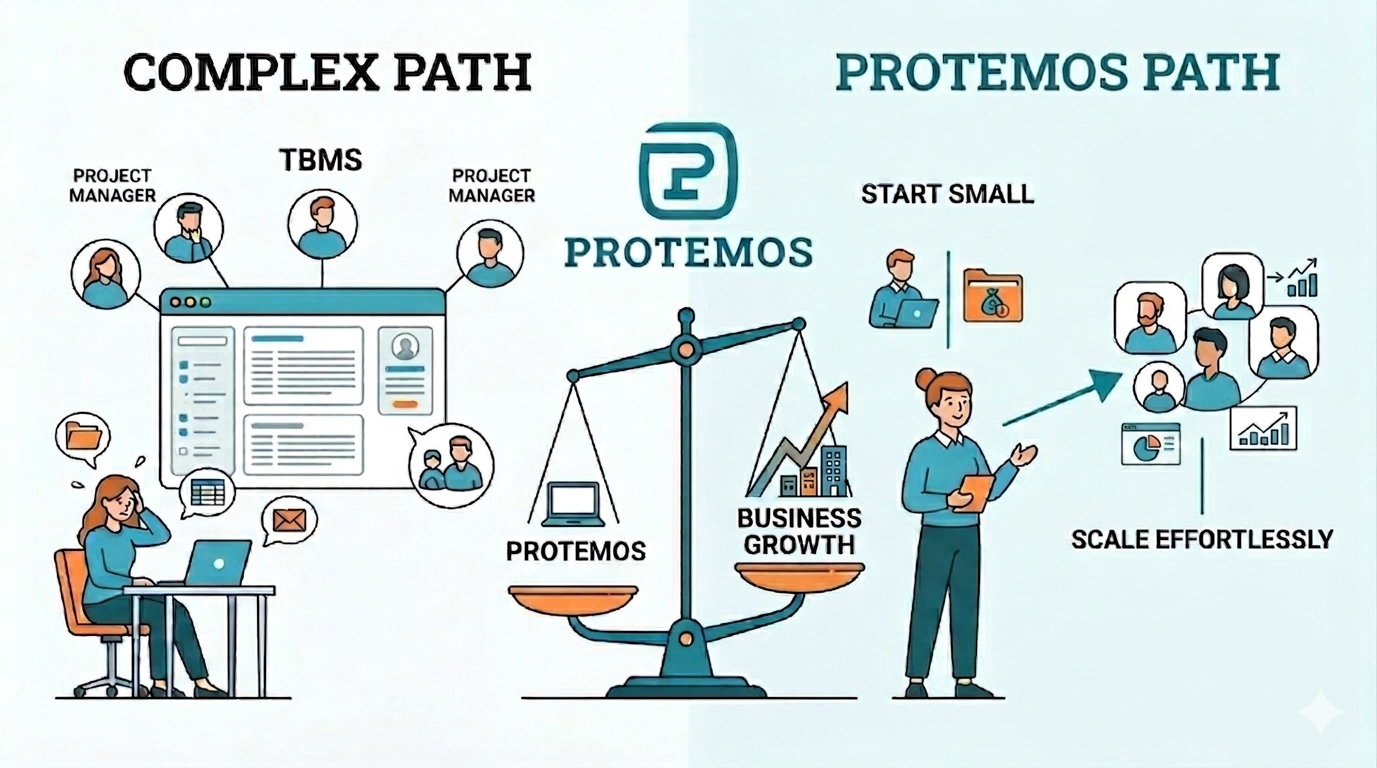
We believe that a TBMS should match the stage of the company using it. If you are a small or growing LSP, you should be able to start small.
You should be able to:
- Begin with a single license.
- Use the system on real projects immediately.
- Get support without additional fees.
- Expand only when your business actually grows.
This approach removes unnecessary risk and allows you to see real value from the very beginning.
How It Works in Practice
Instead of planning a full rollout, you simply start using the system. One person, real work, no artificial requirements. You run a few projects through the TBMS, track costs and revenue, and see how it fits your workflow. Then, as your team grows or your processes evolve, you add more users.
This is how most small businesses actually operate. Step by step, based on real needs.
Our Approach
At Protemos, this philosophy is at the core of how we design and deliver our TBMS.
- You can start with just one license.
- There is no implementation fee.
- You receive full support from the beginning.
- You get access to all the necessary functionality without being forced into a larger commitment.
And when your business grows, you can scale your usage accordingly.
Final Thought
Choosing a TBMS should not be a difficult financial decision. It should be a practical step toward better organization, clearer finances, and more efficient work.
For small translation companies, the most important factor is not the size of the system, but how easily you can start using it. Because the best TBMS is not the one you plan to implement someday. It is the one you can start using today.
.png)
.png)

